What is a book when it no longer requires paper? When it needs no ink, no binding, no truck to carry it from warehouse to shelf? The question feels new, sharpened by algorithms and large language models, but it isn’t. We’ve asked it before, every time the cost of making words permanent dropped low enough to scare us.
Let me take you back to a time most people have forgotten, or never knew in the first place. Not to the age of illuminated manuscripts or Gutenberg’s press, but to something more recent and more quietly brutal: the 1970s, when writing meant feeding paper into a typewriter and praying you wouldn’t make a mistake.
People imagine that era differently than it was. They picture writers at desks, reams of paper stacked nearby, cigarette smoke curling toward ceiling fans, the romantic clatter of keys. What they forget is the cost. Not the emotional cost or the cost of time, though those were real. I mean the actual, wallet-draining price of paper.
In 1975, if you wanted to type a manuscript, you bought bond paper. Twenty or twenty-four pound weight, often with cotton fiber for durability and a surface that wouldn’t shred under the hammer of metal type bars. It came in small quantities because that’s what people could afford. Twenty-five sheets might run you a dollar and a quarter to two dollars. Fifty sheets, two-fifty to four dollars. A hundred sheets, if you were feeling ambitious or reckless, four to seven dollars.
Let’s use a middle number. Fifty sheets for three dollars in 1975. That’s six cents per sheet. Adjust for inflation, and you’re looking at thirty-three to thirty-six cents per sheet in today’s money. Compare that to modern copy paper at two cents a sheet, and you begin to see the shape of the problem. Typing paper in the 1970s cost fifteen times more per sheet than the paper we thoughtlessly jam into printers today.
Fifteen times.
There’s a reason office workers pilfered supplies like Cold War spies. Pens, paperclips, stamps, envelopes—all of it walked out in purses and briefcases and coat pockets. But the budding authors, the ones pecking away at novels in the evenings and on weekends, they were the worst offenders. A ream of bond paper from the supply closet was worth more than lunch money. It was possibility, measured in pages you could afford to ruin.
Because the real punishment wasn’t in the paper itself. It was in the errors.
When you made a mistake on a typewriter, you didn’t backspace and delete. You had choices, none of them good. You could use white-out, which left a chalky smear that screamed amateur. You could use correction tape, which was better but still visible under scrutiny, a little bandage over your incompetence. Or you could pull the page out, crumple it into a ball of expensive failure, and start over.
Starting over meant retyping the entire page. If you were three paragraphs down and caught a misspelled word at the top, you retyped everything. Every. Single. Word. If you were making carbon copies—and many writers did, for backup or simultaneous submissions—the stakes multiplied like a cruel math problem. Two to four layers of paper and carbon paper meant thicker stacks, higher error rates, and multiplied loss per mistake. One error could cost you four sheets at once.
Typing wasn’t drafting. It was manufacturing. You were producing a physical artifact with every keystroke, and every error had a price tag attached. The paper was gone. The time was gone. The fragile thread of thought was snapped and had to be rewound by hand.
This is why most aspiring writers in that era didn’t have failed novels sitting in drawers. They had failed first chapters. Maybe a second chapter if they were stubborn or well-funded. The economic barrier wasn’t just high—it was insurmountable for sustained work. You couldn’t afford to explore a bad idea for three hundred pages. You couldn’t afford to discover at page two hundred that your protagonist was all wrong. The cost of paper and the cost of error created a brutal selection pressure that had nothing to do with talent and everything to do with resources.
Writing became a test of endurance before it could become a test of ideas. You needed motor precision, visual accuracy, memory continuity, and tolerance for irreversible loss. If your hands shook, if your eyes blurred after hours of close work, if your thoughts moved faster than your fingers could follow, you paid for it in paper and time and mounting frustration. The medium filtered people out long before their ideas could be judged on merit.
Then the word processor arrived, and the entire edifice collapsed overnight.
Text became infinitely revisable before it touched paper. You could write a sentence, delete it, rewrite it, move it three paragraphs down, delete it again, resurrect it, and never lose a sheet. Paper flipped roles. It was no longer your workspace, no longer the expensive canvas on which you composed. It was the output artifact, the thing you printed only when the work was done, when you were sure.
Once that shift happened, paper stopped needing dignity. Cotton bond disappeared from everyday use. Thin, cheap copy paper flooded the market like a broken dam. Reams became household items, sold by the case at warehouse stores. The cost dropped because the function had changed.
Here’s the line people miss: the word processor didn’t make paper cheaper. It made mistakes free.
Once error cost went to zero, authorship stopped being an endurance test. You could revise without penalty. You could experiment without waste. You could think in text instead of around it, write badly on purpose just to get the shape of an idea down, then carve it into something better. The cognitive load shifted from “don’t make a mistake” to “make it better.”
The word processor worked so well that everyone could write. Everyone could revise. Everyone could format publishable text with justified margins and professional fonts. Microsoft Word became the universal standard, and it succeeded beyond anyone’s reasonable expectation. Writing was democratized in a way that would have seemed like science fiction to the paper-stealing novelists of 1975.
Then Amazon arrived, and we discovered what happens when distribution costs collapse in parallel with creation costs.
Suddenly, for the first time in history, writers had failed novels sitting in drawers. Entire manuscripts, complete or nearly so, written and revised and polished and still not good enough. Because now they could afford to finish them. Now they could afford to explore dead ends, to write themselves into corners, to discover two hundred pages in that the whole thing was misconceived.
And many of those writers, emboldened by the ease of creation and the seductive promise of self-publishing, uploaded those failed novels to Amazon.
Bad writing didn’t appear because of Amazon. But the scale of it, the sheer searchable volume, was new. What used to die quietly in a desk drawer now had an ISBN and a cover and a price tag. The slush pile went public, and suddenly we could see exactly how much of it there was, how much there had always been, lurking in potential.
The tools reduced production friction. They didn’t create judgment, taste, or structure. Those had to come from somewhere else, and often didn’t. A word processor couldn’t tell you your protagonist was flat or your pacing was broken. It just made it easier to finish the broken thing.
Now we stand at the next collapse, and the panic sounds like an echo of an echo.
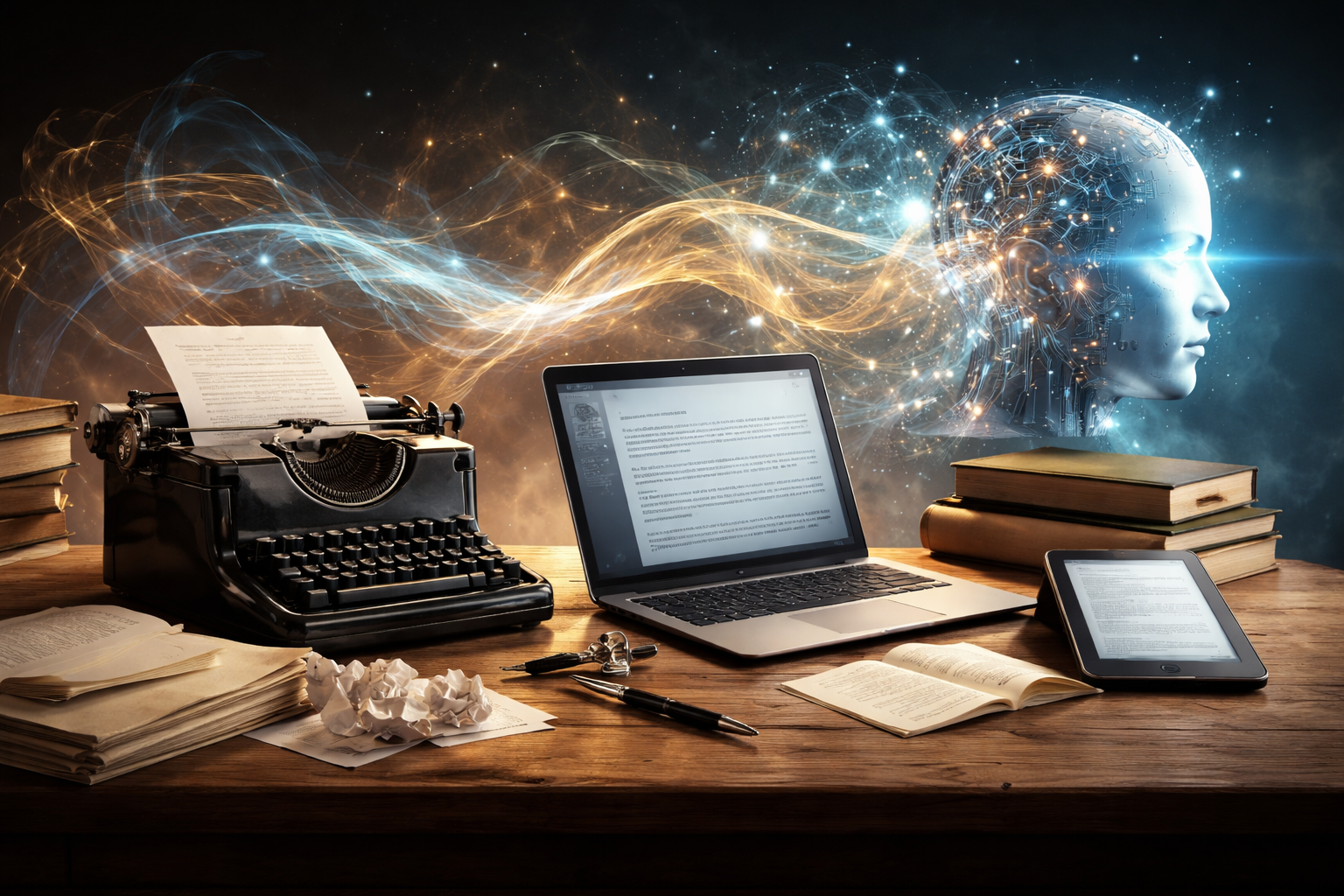
AI doesn’t write books. It transcribes and structures ideas at a speed and scale that used to require either exceptional skill or exceptional privilege. It removes transcription as a bottleneck the same way word processors removed paper as a bottleneck. The comparison is nearly exact.
People worry about quality, and I understand why. We’re about to see an explosion of completed work that previously would have died at the thinking stage, killed by the friction of getting ideas into durable form. But I also remember the mountains of human-authored, Word-enabled manuscripts that already saturated Amazon before large language models existed. Much of it was worse—structurally, grammatically, conceptually—than anything an algorithm has produced. The variable that determines quality has never been the tool. It’s always been standards, editing, and judgment.
AI didn’t introduce noise. It exposed how little filtering remained after we removed all the economic barriers.
I think about the people who were excluded from writing not because they lacked ideas, but because their hands couldn’t type for long periods. Because their eyes couldn’t track lines of text without losing their place. Because dyslexia turned transcription into an hourly struggle that drained the day’s energy before a single good sentence appeared. Because their thoughts moved faster than any transcription method could follow, and the gap between conception and execution was too wide to bridge.
The cost of paper and the cost of error enforced a gate most people didn’t see. It looked like craft. It looked like discipline. It looked like the natural selection of talent. But it was capability gating, pure and simple. If you couldn’t endure the manufacturing process, if you couldn’t afford the paper or the time or the physical stamina, your ideas stayed silent. We mistook economic exclusion for quality control.
Every time the cost of expression drops, voices multiply. Authority weakens. Gatekeeping rebrands itself as standards. Paper once enforced silence. Then typewriters. Then the physical stamina to type for hours. Then editors and agents and publishing houses. Then formatting and cover design and distribution networks.
AI removes the last mechanical excuse.
A book was never paper. Paper was the price of admission in a pre-digital economy, the toll you paid to make thought durable. Once that price collapses, the definition of a book has to survive without it, or we have to admit it was never about ideas at all. It was about who could afford to have ideas that mattered, who could pay the manufacturing cost of making them permanent.
A book is sustained meaning made durable. The substrate has changed before—papyrus to vellum to paper to pixels. It survived every transition. This one will be no different.